finds
findsWhat the OOTDBuy Spreadsheet finds pages actually are
People still call these things spreadsheets. Nobody has opened a shared file for years. What the name points at now is a browsable catalogue of product cards, sorted by category, each one linking out to a Chinese marketplace listing.
Understanding exactly how much information is on a card, and how much is not, is the difference between a good first order and an expensive lesson.
One card at a time
What is on the card, on the listing, and nowhere yet
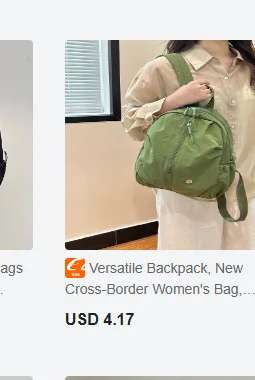
A card carries four things: an image, a name, the marketplace badge and a link. That is deliberate. It is an index, and an index that tried to hold prices and stock would be wrong within a week.
The listing page behind it carries the evidence: the seller and its trading history, the current price, the variants that are actually in stock, buyer photos taken by people who are not the seller, and the sellers own measurement table in centimetres.
Two things are on neither. Your size in this particular makers cut, and whether the item can travel on the line that serves your country. You settle the first on the listing page and the second on the OOTDBUY restricted list, and both happen before you pay for anything.
The two entrances, and when to use each
You can arrive at the same item from either end. They suit different moods and produce different results.
Browse a category
Best when you know the kind of thing you want but not the exact item. You see what is common in that category, which is how you learn what a normal price and a normal photo set look like.
Open the hoodie categorySearch resultsSearch for a specific thing
Best when you already have a name or a screenshot. Narrower, faster, and it skips the education that browsing gives you.
Try a search for cargo pantsWhy the card cannot tell you the price
The number on a Chinese marketplace listing moves. Sellers run their own promotions, variants are priced separately, and the same item from the same shop can cost different amounts on different days. A catalogue that printed a price would be publishing a stale number at scale.
The same goes for stock. Cards outlive listings. Some of what you click will be gone, and that is normal rather than a sign that something is broken. When it happens, search the item name on the marketplace instead of assuming the card was wrong.
What you should take from a card is the shape of the thing and where to go look. Everything with a number attached belongs to the listing or to OOTDBUY.
From card to order without skipping anything
Five steps. The first three cost nothing and take about two minutes each.
Open the card and then the listing
Read the listing, not the card. If the listing is dead, search the name on the marketplace before giving up on the item.
Check the category rules
Some categories touch the restricted list. Two minutes here saves an entire order. Open the category brief
Take the measurements off the listing
Centimetres, flat, compared against something you own. Never a letter, never a conversion chart. How to do this
Paste the link into OOTDBUY and choose the variant
Colour, size and remark go on the order line. This is where a wrong variant becomes expensive.
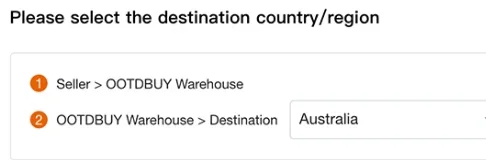
Official OOTDBUY tutorial image. The destination is set on the order, not at checkout. Wait for the photos, then decide how it ships
The photo set is your last look before it leaves China. What happens after that
Why use the spreadsheet instead of searching yourself
You could search the marketplaces directly. Plenty of people do. The reason to start from a catalogue is that the Chinese search terms for most of what you want are not the English ones, and the results you get by translating a phrase are frequently not the item at all.
A catalogue page has already done that step. It also tends to surface what other people have actually ordered, which is a weak signal but a real one: listings that survive in a catalogue are usually listings that stayed up and kept shipping.
What it is not is a quality ranking. Nobody has handled these items. Treat a card as a shortlist entry and do the checking yourself.
How this list is kept, and what we do differently
A catalogue card carries four things: one photo, a small badge for the marketplace it came from, a title cut off mid sentence, and a price in dollars. That is the whole card. The title is the sellers own wording, truncated to fit, so the words that would tell you the fabric or the cut are usually the ones that got cut.
We supply the missing half: the measurement worth asking for, the policy that governs that category, and the point at which an order can still be stopped. Every category brief on this site names the official notice it came from and the date we read it, so you can check us rather than trust us.
We recheck the official notices on a schedule rather than when something looks wrong, and the result goes on the updates page with its date, including the checks where nothing had changed. A list that only publishes the months it found something is a list you cannot tell apart from one nobody is reading.

How to judge a finds site before you trust its links
Four checks, and none of them needs an account. First, open three links from different categories. If one of them lands on a removed listing, the list is not being maintained, because removed listings are the normal state of this catalogue rather than the exception.
Second, hunt for dates. Footer copyright years do not count. What counts is a date sitting beside each claim, so you can tell when somebody last verified it. Third, see whether the site says anything that costs it money to say, such as naming the categories that are a bad idea to order. Where every answer is encouraging, you are reading marketing that happens to be searchable.
Fourth, see whether it names an operator you could write to. Our own answer to all four is on the about page, and it is the same standard we are asking you to hold other sites to.